
Randolph Correctional Center Release Paths
Randolph Correctional Center is operated by NC DAC, not the Randolph County Sheriff's Office. Someone departing this institution may be transferred within the state prison system, released to the community at the end of active incarceration, or released under post-release supervision or parole when applicable. A transfer preserves incarceration. Community supervision places the person outside prison but under conditions, and final discharge is a separate status.
The public record must be read across fields. A current or previous location identifies where DAC reports the person, while the last movement explains a change. Inactive incarceration paired with an Actual Release Date supports a completed prison release. Active supervision may appear at the same time and can identify probation, parole, or post-release supervision. A county name displayed as the location on an inactive record may describe a community-supervision location, not a prison.
The Randolph County released inmate guide separates these state records from county-jail releases. Never use the Sheriff's currently confined roster to decide whether a person has left Randolph Correctional Center. That roster covers Sheriff custody and does not mirror DAC prison movements.
Confirm Randolph Correctional Center Releases
Begin with the NC DAC Offender Public Information search. The form supports searches by offender number, name, gender, race, birth date, and age range. An offender number is the strongest starting point. If using a name, compare birth information, aliases, physical descriptors, sentence details, and locations before selecting a record.
- Open the matching offender detail and review incarceration status, most recent incarceration, current and previous location, and last movement.
- Compare Projected Release Date with Actual Release Date. Projected is a calculation that may change; actual records a completed event.
- Open sentence history to see whether another active sentence, detainer-related movement, or consecutive term affects the result.
- Review supervision status. Active parole or post-release supervision means the person is in the community under DAC authority, not wholly discharged.
- Use the DAC Inmate Releases search as a second route for completed events, then contact DAC if public fields conflict.
The release search accepts county, year, and month together, or a last name. Results can include offender number, name, release date, primary offense with a qualifier, and type of release. The meaning of its County field was not defined in the reviewed public material, so avoid stating that every Randolph-filtered result was released from Randolph Correctional Center. Verify the person's movement detail.
Randolph Correctional Center Release Records
Facility staff route operational questions, while NC DAC public records and OPI supply the documentary release and status paths.
Randolph Correctional Center
2760 US 220 Highway Business
Asheboro, NC 27203
Mail: Box 4128, Asheboro, NC 27204
Phone: 336-625-2578
North Carolina Department of Adult Correction
Main: 919-733-2126
Institutions: 919-838-4000
Community Supervision: 919-716-3100
Public records: DAC online request route
Facility staff can route operational questions, but privacy and security rules limit what they may disclose. Public offender status and history should first be checked in OPI. For a record copy or correction, use the NC DAC public-records page and identify the offender number, record type, and date range. Include the date and wording of any disputed public field. A request for an existing record is clearer than asking DAC to calculate a release date or create a new analysis.
Questions about active community supervision go to the responsible supervision office or Community Supervision at 919-716-3100. The Post-Release Supervision and Parole Commission can be reached at 919-716-3010 for matters within its authority. NC SAVAN at 1-877-627-2826 offers automated status and notification assistance, but an alert remains tied to the reporting agency and event.
About Randolph Correctional Center
DAC describes Randolph Correctional Center as a minimum-custody institution for men, a reentry facility, and the site of 68 long-term medical beds. Its reported capacity is 226. These figures describe the institution, not the current count or any individual's status. The prison's minimum-custody designation also does not guarantee a particular release date or release plan.
As a state prison, the facility houses sentenced people in the DAC system rather than the pretrial and local-sentence population associated with the county detention center. Visitation requires the current DAC approval and scheduling process. Mail, deposits, telephone access, and visitation must follow current state rules. Confirm them with DAC before acting, since operational instructions can change and are separate from release-status records.
Randolph Correctional Center Facility Record
The official Randolph Correctional Center profile identifies the operator, address, custody level, capacity, programs, and local history.
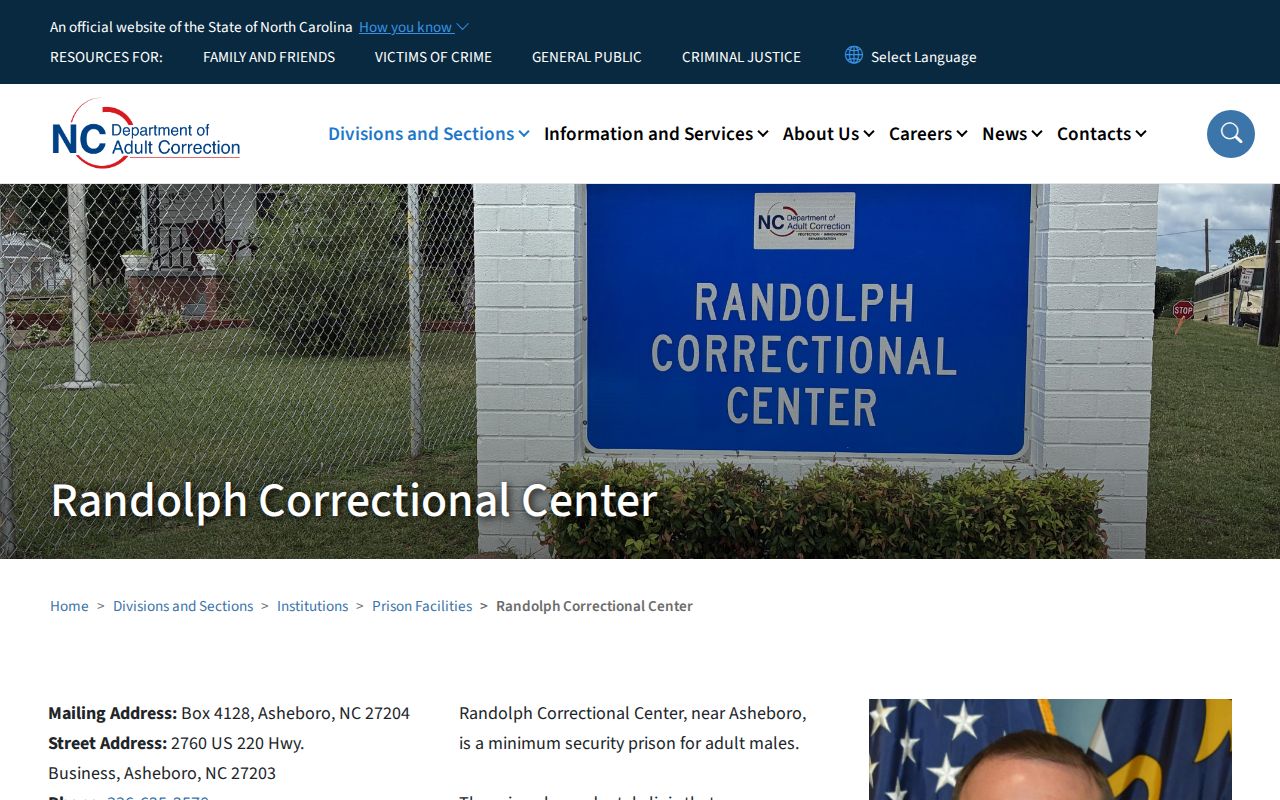
Use the official facility profile to confirm institutional facts and current operational links. It is not a live roster and does not, by itself, show whether a named person was released or transferred.
Request Randolph Correctional Release Records
A useful DAC request names the offender number and asks for specific existing material, such as movement history, an actual-release entry, sentence history, or the record supporting a displayed status. OPI is the public starting point. Save the fields and access time because records can change after audits, amended judgments, new sentences, disciplinary credit changes, detainers, or revocations.
Projected Release Date is not a promise. For a structured-sentencing felony, North Carolina law generally requires service of the judicial minimum subject to defined exceptions, while earned time may reduce the maximum without reducing it below that minimum. Multiple sentences and mandatory post-release supervision make simple percentage calculations unreliable. The displayed calculation can move as the controlling record changes.
After the event, look for inactive incarceration, Actual Release Date, last movement, and any active community supervision. If a projected date passes while incarceration still appears active, ask DAC to explain the operative record rather than assume unlawful confinement or a website error.
OPI can retain information that remains useful after a release, including aliases, demographic identifiers, sentence entries, conviction county, supervision periods, and a DAC offender photograph. Historical entries should be read as history, not evidence that every sentence or custody status remains active. Likewise, an offender photograph is a state identification image and not necessarily a Randolph County booking photograph. When documenting a completed release, preserve the Actual Release Date, release or last-movement description, incarceration status, and any separately active supervision. This combination is more informative than a single date and reduces the risk of confusing release from prison with full discharge from state authority.
Randolph Correctional Center Release History
Randolph Correctional Center's history reaches back to the state's 1931 assumption of county prisons and its later development as a field-unit institution. The Conner Bill and work-unit history provide legitimate local context for how the site developed. They do not establish a modern sentencing credit or release rule. Current calculation comes from the applicable judgment, statutes, DAC credit rules, and record audit.
The historical contrast with the county jail is especially useful. Randolph County Detention Center expanded to a reported 422-bed capacity and completed renovations in early 2024. Randolph Correctional Center reports 226 minimum-custody beds and belongs to the statewide prison system. Similar geography and the shared Randolph name should never substitute for identifying the operator and source system.
Randolph Correctional Release Supervision
North Carolina post-release supervision begins when an eligible person leaves active prison custody. Parole applies mainly to certain older-law cases, while probation can arise from a court sentence without a prison release from this facility. OPI may display active community status, begin and end dates, officer or office information, and previous supervision. Use the exact label rather than calling every supervised person a parolee.
A person can therefore be released from Randolph Correctional Center while remaining under DAC authority. Conditions and exact case details come from DAC and the supervising office, not from an inference based on a facility change. The public record should preserve the exact probation, parole, or post-release label.
Verify Randolph Correctional Release Status
Match offender number, full name, birth date, aliases, sentence information, and agency before relying on a record. Then distinguish the status being reported. “Transferred” means continued custody. “Inactive incarceration” supports departure from prison but may coexist with active supervision. “Actual Release Date” documents a historical event. “Projected Release Date” remains conditional.
NC SAVAN, OPI, DAC Inmate Releases, and facility staff cover different parts of the same question. When two sources appear inconsistent, note the update time and ask DAC to reconcile the fields. Corrections to DAC information belong with DAC. Court judgment errors belong with the issuing court. Record the exact status label, access date, and movement type before calling so staff can identify which public fields appeared inconsistent.