
Randolph Projected vs Actual Release
The North Carolina Department of Adult Correction uses the exact field label Projected Release Date. It can appear in the latest incarceration summary and again within individual sentence records. The same detail may later show an Actual Release Date. These fields serve different purposes. A projected date is a calculation that can move. An actual date records a completed sentence event, although the person’s identity, incarceration status, and last movement should still be checked.
A Randolph County jail detainee awaiting trial usually has no sentence-based date to compute. Bond may permit release, a judge may enter an order, or another hold may keep the person confined. Court action can occur before jail processing ends. A person transferred to NC DAC or another agency has left the Randolph booking but has not been released to the community.
Randolph Pretrial Release Has No Date
A person held at the Randolph County Detention Center before trial does not have a sentence-based projected release date. Release may depend on satisfying bond, a judge changing conditions, a dismissal, or another court order. Even then, jail staff must finish the booking-out process and check for other holds. The legal event and the physical departure can occur at different times. A court docket can explain authorization, but only the jail or its release record can confirm when Randolph custody ended.
Electronic house arrest can also place a person outside the jail under controls. The Sheriff states that a judge generally orders the program, although a magistrate may set it as a release condition. Bond and program approval come before monitoring requirements. That event is a physical release from the detention center, but it is not earned-time discharge from a sentence. If another county, NC DAC, USMS, or ICE receives the person, the Randolph booking closes through transfer rather than community release.
Use the Randolph current roster hub only to establish current confinement at the time checked. Its four daily updates do not calculate a future event. A missing name is a reason to call, not a date.
Note: A court order can authorize release before the detention center completes its checks and records the physical departure.
Find Randolph County Release Dates
For a state prisoner, start with the NC DAC Offender Public Information search. An offender number is more reliable than a name. When it is unavailable, combine the name with birth date or age range, sex, race, middle initial, aliases, and other displayed identifiers. Select All if the current status is uncertain. Then open the record and read the incarceration summary, sentence history, last movement, detainer indicators, and probation, parole, or post-release blocks together.
For a county sentence, contact the Randolph County Detention Center at 336-318-6625 and use the court case to identify the controlling judgment. The sheriff’s current roster is not a future-date system, and it removes people who are no longer confined. If documentary confirmation is needed, Sheriff Records can be reached at 336-318-6698. The Randolph court directory provides clerk and magistrate contacts, while the full Randolph County released-inmate search path explains how jail, SAVAN, court, and records-request evidence fit together.
- Classify the case as pretrial county custody, a county sentence, or a state-prison sentence.
- For state custody, search OPI and match the offender number plus identity details.
- Read each sentence line, since separate terms may show different projected dates.
- Check whether terms are concurrent or consecutive and whether another hold appears.
- For county custody, use the judgment and ask the jail for the recorded calculation.
- After the date, verify the actual release or transfer through the owning agency.
The NC DAC Inmate Releases search provides a released-first view with county, year, month, or surname inputs.
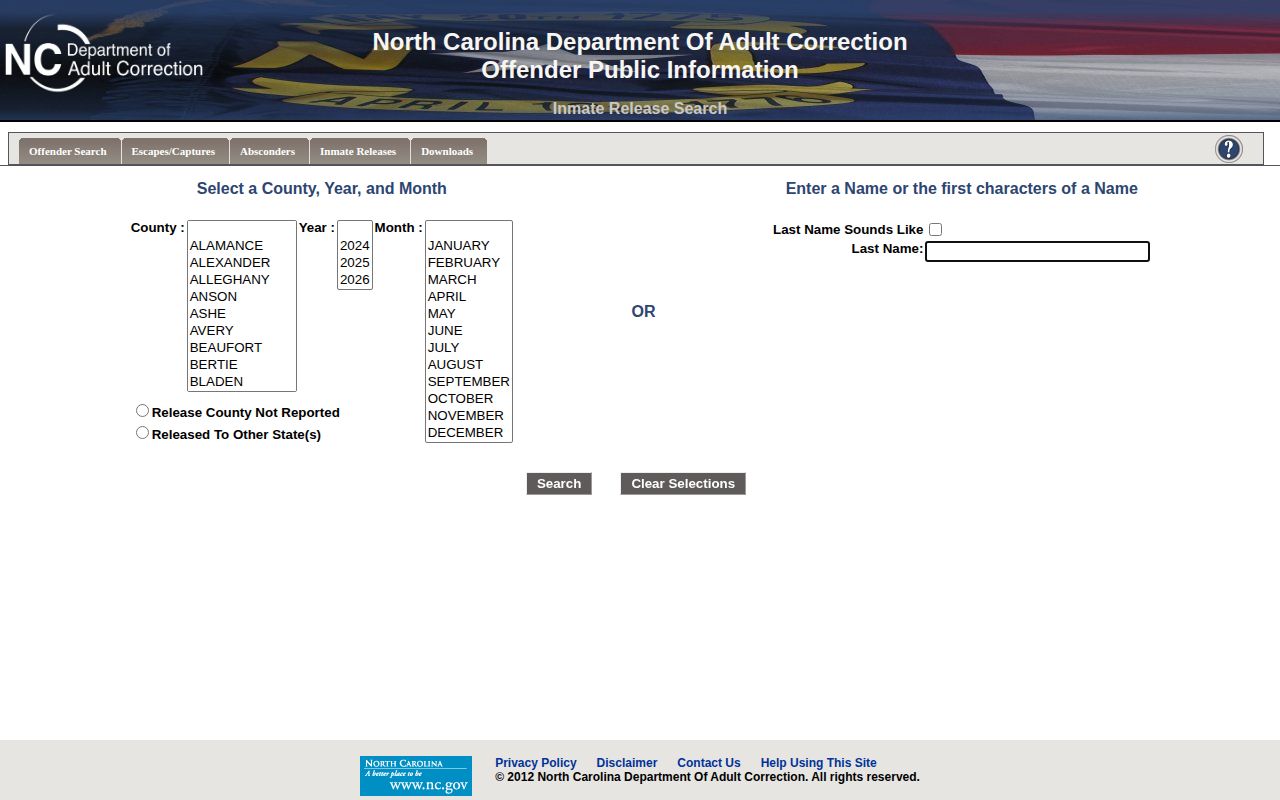
Its result columns include release date and type, but its County label is not defined as a county-jail source and must not be treated as one.
Randolph Release Sentence Minimums
North Carolina structured sentencing begins with the judgment’s minimum and maximum terms, not a simple percentage of a headline number. For an active felony punishment, G.S. 15A-1340.13(d) generally requires service of the minimum term imposed, subject to the exception stated in the statute. Earned time may reduce the maximum term, but it does not reduce that sentence below the judicial minimum.
The sentencing tables and maximum-term rules appear in G.S. 15A-1340.17. The computation also depends on the sentence start date, jail credit, offense class, sentence date, and whether multiple terms run together or one after another. A public OPI date reflects the agency’s operative calculation. A private arithmetic estimate cannot account for every audit, credit decision, amended judgment, or special statute.
- Concurrent
- Terms run at the same time, subject to the judgment and governing law.
- Consecutive
- One term follows another, which can move the projected release date.
- Jail credit
- Eligible time already spent in custody that the official calculation applies.
- Earned time
- Credit awarded under governing rules, with effects limited by the sentence statute.
Read Randolph Projected Release Records
An OPI detail can place several dates on one screen. The incarceration summary may carry the current Projected Release Date, while individual sentence rows can carry their own projected and actual fields. Sentence history can also show conviction county, docket, sentence begin date, punishment, minimum and maximum terms, offense class, and parole dates. Those fields must be read as a set.
The status blocks answer a different question. Active Inmate means the state still lists the person in its prison system. Active Probationer-Parolee means the person is in the community under DAC supervision. Inactive means the person was formerly active in one or both roles but is no longer active. A projected date beside active incarceration is still a future calculation. Inactive incarceration plus an actual release and matching movement is stronger historical proof.
| OPI field | Meaning |
|---|---|
| Projected Release Date | A changeable agency calculation, not a completed event |
| Actual Release Date | A date recorded after the sentence event |
| Last Movement | Context for release, transfer, or another location change |
| Incarceration status | Whether the state prison role is active or inactive |
| Probation, parole, or PRS status | Whether DAC community supervision remains active |
Randolph Release Earned-Time Rules
G.S. 148-13(a1) directs the DAC Secretary to adopt rules governing the rates and circumstances for earned time. Those rules operate within the sentence law. Credits may affect the maximum term, and later discipline can lead to loss or restoration. They do not allow a reader to subtract an assumed number of days and publish a guaranteed release date.
Misdemeanor sentences have a separate provision. G.S. 15A-1340.20(d) authorizes earned time and generally caps combined credits at four days per month. Randolph County did not publish a local good-time table or weekend-release policy in the official research sweep. For a county misdemeanor term, ask the jail for the date recorded in its system and the legal authority used. A bond or dismissal release is not an earned-time calculation.
Note: Randolph County publishes no local table from which a dependable county-jail release date can be calculated independently.
No Blanket Randolph 85% Rule
North Carolina does not impose a universal statute requiring every prisoner to serve 85 percent of a headline sentence. The judicial minimum and maximum under Structured Sentencing can produce a rough relationship sometimes described that way, but the phrase hides key differences. Offense class, sentencing date, sentence structure, earned credit, mandatory supervision, and special provisions all matter.
Use the exact judgment and OPI record. Do not apply a percentage to an arrest date, bond amount, or maximum term in isolation. Older-law parole cases follow their own eligibility rules, and a possible parole review does not make the projected date a promise. If a state record and court judgment appear inconsistent, ask DAC to explain the current calculation rather than choosing the date that seems most plausible.
Randolph Post-Release Transition Date
Mandatory post-release supervision can control when prison confinement changes to community supervision. G.S. 15A-1368.2 sets release to PRS at the maximum term less the periods stated for the applicable sentence and offense category, subject to earned time and other provisions. The law also says a prisoner may not refuse PRS. G.S. 15A-1368.5 provides that PRS begins on the day of release.
This transition means a person can be released from prison while remaining active in DAC’s community system. In OPI, look for inactive incarceration paired with active post-release, probation, or parole status and a named office. The duration and calculation are not one-size-fits-all. Current statutory provisions distinguish sentence and offense categories, including registration-related cases, so the live record and controlling judgment are essential.
Why Randolph Release Dates Change
A projected date can change before the person moves. Some changes arise within the sentence calculation. Others come from a new court or agency event. Reading only one date misses this context. OPI may show multiple sentence entries, movement dates, locations, and detainer indicators, all of which should be reconciled before drawing a conclusion.
| Factor | Possible effect | Record to check |
|---|---|---|
| Credit award, loss, or restoration | Recalculates the eligible date within statutory limits | DAC sentence calculation and OPI |
| Concurrent or consecutive treatment | Changes how multiple terms combine | Judgment and sentence history |
| Amended court order | Changes the controlling term or credit | Court file and updated DAC record |
| Detainer or another agency hold | Can prevent community release or cause transfer | DAC or jail movement record and receiving agency |
| Revocation or added sentence | Adds custody or changes the projected endpoint | Court disposition and DAC status |
| Parole decision | May affect an eligible older-law case | Commission result and OPI |
A projected date that has passed while incarceration remains active calls for agency confirmation. It does not, by itself, prove a bad calculation or completed release.
Note: A changed date can reflect a lawful new event, so preserve the judgment, access date, and full OPI status.
Confirm Randolph County Actual Release
After the expected date, look for inactive incarceration, an Actual Release Date, and a last movement consistent with release. If the record shows a new prison or receiving authority, the event was a transfer. Active community supervision can follow a valid prison release. The Randolph County VINELink check can provide a custody-change alert, but the event is limited to the reporting agency and should be read with any destination language.
For county custody, call the detention center and ask whether the booking ended through release or transfer. Then use the court disposition to explain the legal event and request the existing booking or release record when a timestamp or receiving agency is needed. For state custody, DAC owns the operative calculation. A projected date is complete only when the actual movement and status records agree.