
Randolph County Release Meaning
A Randolph County release record must distinguish the end of one agency's custody from freedom in the community. Bond, a court order, time served, sentence expiration, electronic house arrest, parole, or post-release supervision may put a person outside a jail or prison. A transfer to another jail, NC DAC, the U.S. Marshals Service, or ICE only closes the first booking. Custody continues elsewhere. Death also ends a custody record, but it must never be called an ordinary release.
The official Randolph County list is labeled Currently Confined Inmates. It tracks people who are in the county jail now. Once a booking ends, the entry normally drops from that public list rather than moving into a released tab. The lasting proof may instead be a Sheriff booking and release record, a SAVAN custody event, an NC DAC history, or a court disposition. Those sources record different parts of the story.
- Discharge
- The formal end of a sentence or supervision obligation.
- Time served
- Release after the credited custodial term has been completed.
- Parole
- Supervised early release for eligible older-law state sentences.
- Probation
- Court-ordered community supervision, often imposed instead of prison.
- Detainer
- A request or hold that may send a person to another agency instead of the community.
Randolph County Release Types
The type of release controls which record should appear next. A county detainee who posts bond remains connected to a pending court case. Someone who finishes a county sentence may have no further custody, while a person sent to Randolph Correctional Center enters state prison custody. For a state prisoner, parole and post-release supervision both mean prison custody ended but NC DAC supervision remains active. The words on the record matter.
| Release or movement | Meaning | Best next record |
|---|---|---|
| Bond or pretrial release | County confinement ends while the case continues | Sheriff release record and court case |
| Time served or expiration | The recorded custodial term ends | Jail record or NC DAC actual release history |
| Electronic house arrest | Physical release with monitoring and conditions | County detention and court records |
| Parole or post-release supervision | Prison ends and community supervision begins | NC DAC OPI supervision status |
| Transfer | One booking ends but custody continues | Sending record plus receiving agency locator |
| Dismissal or acquittal | A court outcome that may support release | Court disposition plus physical release record |
A court event may occur before jail staff finish checking for other holds and processing the person out. For that reason, a dismissal or bond order is legal support for release, not the door-opening time. Likewise, probation is not proof of a prison discharge. Match the event to the agency that controlled the person at that moment.
Randolph County Release Record Fields
A focused county request asks for existing fields tied to one booking. It should not ask staff to create a new narrative. Randolph County's public roster already supplies booking facts, alleged offenses, court references, bond details, an arrest agency, and often photographs while a person remains confined. It does not show a release date, release reason, destination, or released-record retention window. The separate booking and release record is therefore the key county source after the public entry vanishes.
| Field to request | What it establishes |
|---|---|
| Name and booking identifier | Connects the release event to the correct detention record |
| Admission date and time | Marks the start of the Randolph County booking |
| Release date and time | Records when county custody ended |
| Release type or authority | Explains bond, court order, time served, or another legal basis |
| Destination or receiving agency | Separates community release from transfer |
| Charges and court reference | Connects custody to the related court file |
| Bond type and amount | Shows the recorded pretrial terms when disclosable |
| Booking photograph | Identifies the booking image as a separate requested item |
Not every field is public or stored in one report. A transfer destination may require a receiving-agency record. A photograph can receive separate treatment under the law-enforcement records exception. Ask for the fields that exist, request a written statutory basis for any withholding, and avoid assuming that one database contains the entire custody chain.
Request Randolph County Release Records
Randolph County Sheriff Records accepts record questions at 336-318-6698. Sheriff administration is at 727 McDowell Road, Asheboro, NC 27205, and is open Monday through Friday from 8:00 a.m. to 5:00 p.m., except holidays. The county does not publish a dedicated release-record form, a fixed turnaround, or a standard booking-photo fee. Request an electronic copy and a cost estimate before agreeing to a charge.
- Identify the person with a full name, date of birth when appropriate, and the approximate booking or release dates.
- Add the booking number or court reference if it was saved from the current roster.
- Ask for the existing booking and release record, including admission, release time, authority, type, and destination fields.
- Request the booking photograph separately if it is needed, because the custodian may apply a different legal analysis.
- Ask for electronic delivery, a cost estimate, and the statutory reason for any denial or redaction.
727 McDowell Road
Asheboro, NC 27205
Records: 336-318-6698
Administration: 336-318-6699
Monday-Friday, 8:00 a.m.-5:00 p.m., except holidays
The state Sheriff records schedule provides a retention framework, but the exact schedule item and period for each Randolph booking, release, and image series was not verified. Ask whether the specific record still exists. No numerical retention promise should be inferred from the roster.
Randolph County Release Records Law
G.S. 132-1 broadly defines North Carolina public records. G.S. 132-6.2 generally limits an uncertified copy charge to the direct reproduction cost unless another law applies. An agency may add a reasonable special-service charge when a request requires unusually extensive technology or staff work. The custodian need not create a report that does not exist.
Law-enforcement material has real limits. G.S. 132-1.4 excludes criminal-investigation and intelligence records from the general public-record rule, while making listed arrest facts public. Juvenile, medical, victim, sealed, and expunged information may also be withheld or redacted. Prompt access does not guarantee that every requested field or photograph will be disclosed.
Randolph County Monitored Releases
Randolph County documents two ways a person may be outside the jail yet remain under control. Electronic house arrest is usually ordered by a judge, though a magistrate may make it a release condition. Bond and approval come before the monitoring rules. The participant is physically released, but residence, location, testing, and other conditions still apply.
The Adult Day Reporting Center is another local jail alternative. It provides structured pretrial supervision, case management, counseling, and transportation for local clients. Neither path means a sentence was discharged, and neither should be mislabeled parole. The jail, court order, and program record together explain the actual status.
Randolph Release Mail and Property
A former Randolph detainee can request digital copies of ordinary postal mail that the jail scanned to the inmate tablet before destroying the paper original. The request goes to jailmail@randolphcountync.gov and should include the detention center, inmate name, and inmate ID. After verification, the county sends a download link. This is a personal mail-recovery process, not a public release-record request.
Evidence Control has separate, appointment-oriented hours for recovered property and evidence. That unit is not automatically the custodian of personal items inventoried at jail intake. A released person or family member should call the detention center about ordinary release property. Mixing the two routes can delay the request because the records serve different purposes.
Randolph Release Records After Expunction
North Carolina expunction can remove, seal, or destroy eligible state arrest, charge, or conviction records. Under G.S. 15A-146, qualifying cases in which all charges end in dismissal, not guilty, or not responsible may be automatically expunged 180 to 210 days after final disposition, subject to the statute's conditions and exclusions. Investigative records can remain with an arresting agency where law permits.
An empty search later cannot reveal why a record is missing. The court's CR-370 form warns that a file may never have been assigned, may have been deleted, or may have been expunged. Private copies are not automatically erased by the court process. Verify the release through the agency record that remains available and treat a missing case as an absence of public data, not proof of any particular outcome.
Find Randolph County Released Inmates
Begin by deciding whether the last known custody was the county jail, a state prison, federal custody, or immigration custody. Then match the person with more than a name. A booking number, offender number, birth date or age, middle name, alias, court reference, and reporting agency reduce false matches. One source should document the completed custody event, while a second source can explain the legal result or the next agency.
- Search both official Randolph current-list views and save the court reference or SAVAN identifier if the person is still shown.
- Use the linked SAVAN record or the modern North Carolina VINELink person search to check the reporting agency's custody event.
- Call the detention center at 336-318-6625 and ask whether the booking remains active, ended in release, or ended in transfer.
- Check the court disposition for bond, dismissal, sentence, or another order, but do not treat the court event as the physical release time.
- For state custody, inspect NC DAC OPI and its Inmate Releases search. For federal or immigration custody, use the matching federal locator.
- Request the Sheriff booking and release record when an online view cannot document the event.
The official roster sorted by confinement date shows what Randolph publishes online. It is current-only, not a historical release list.
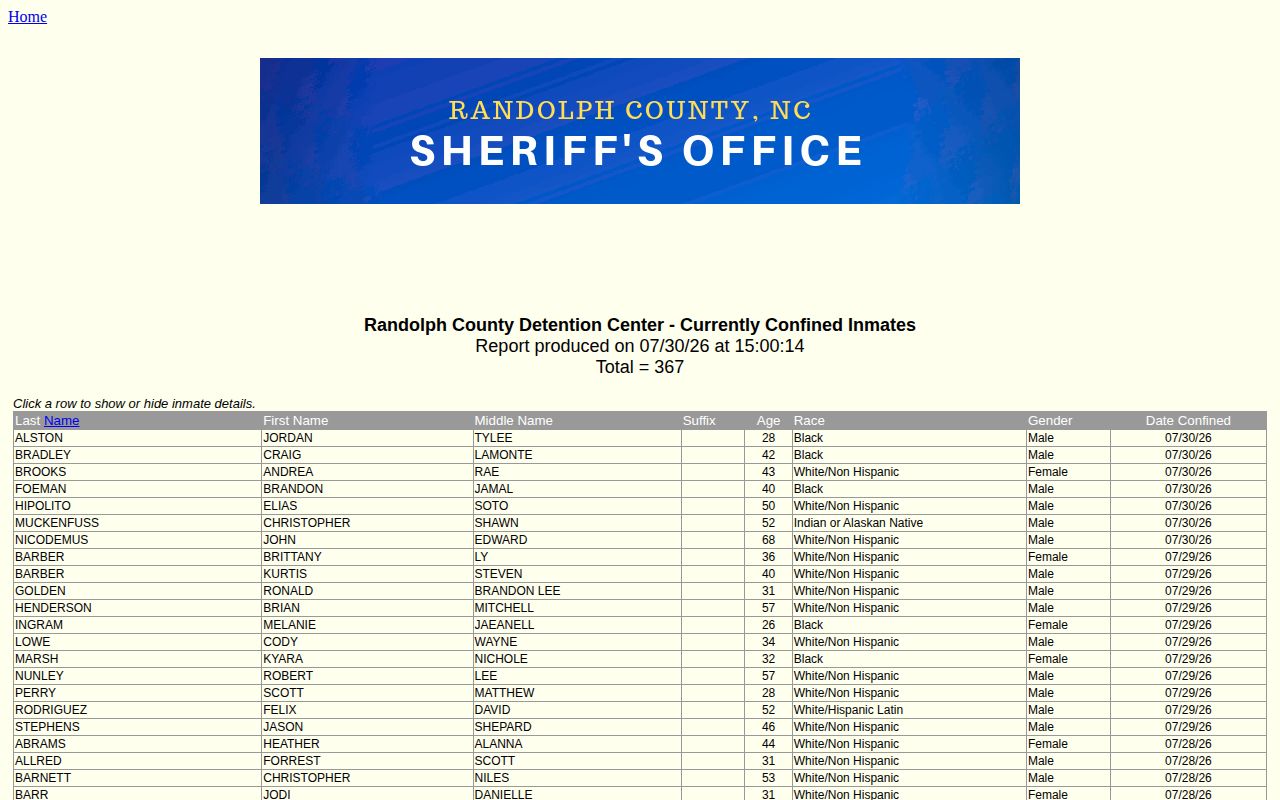
The displayed booking and court fields can support identity matching before the entry drops, but the image itself does not confirm a later release.
Randolph Released Inmate DAC Search
The NC DAC Offender Public Information search is the main statewide route for someone who served a North Carolina prison term or entered DAC community supervision. It is not the record system for a jail-only Randolph booking. Choose All when status is uncertain, use the seven-digit offender number when known, and compare the identity fields before opening a result.
| Search field or status | How to use it |
|---|---|
| Last and first name | Start a name search, then corroborate with other fields |
| Middle initial or Sounds Like | Handle spelling and name variations with care |
| Offender number | Use the seven-digit identifier for the most precise match |
| Birth date or age range | Separate people with similar names |
| Active Inmate | Shows current state-prison custody |
| Active Probationer-Parolee | Shows current DAC community supervision |
| Inactive | Shows a formerly active DAC record that is no longer active |
On the detail page, read incarceration status, Actual Release Date, last movement, sentence history, and probation, parole, or post-release status together. Inactive incarceration plus active supervision means prison custody ended while community control continues. An active incarceration record with a new institution is a transfer. A Projected Release Date is planning data, not proof that release occurred.
The official search form shows the available Randolph County released-inmate lookup fields.
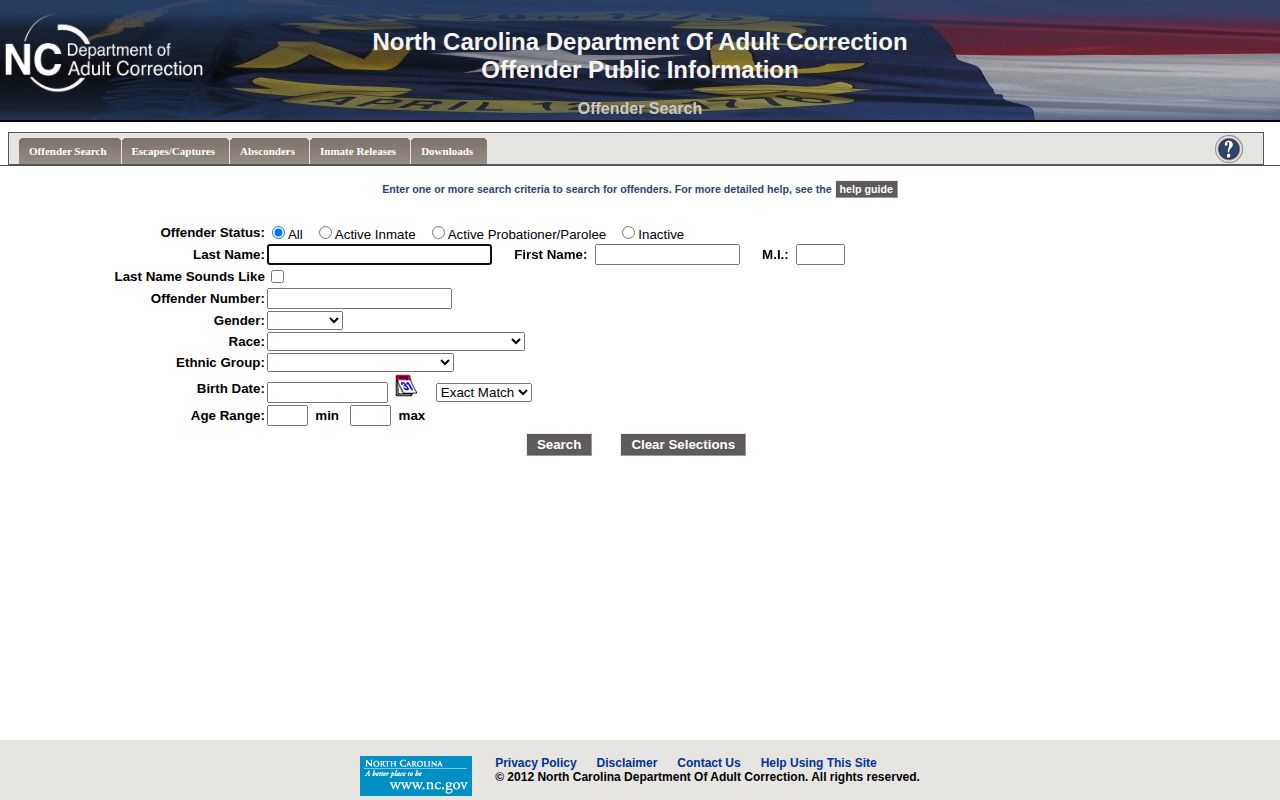
Those filters help match a state offender, while the linked detail supplies the status and movement fields needed to interpret a release.
Randolph County Recent Release Limits
Randolph County, North Carolina publishes no official 24-hour, 72-hour, or recent-releases archive found in the research sweep. The Sheriff offers current lists sorted by date confined and last name. County text says those lists refresh automatically four times daily and may lag fast changes. That cadence refreshes the present jail population. It does not create a list of people who left during the prior day or three days.
The practical fallback is specific-person confirmation. Call the jail, use SAVAN, review the court case, and request the booking and release record. If a date-range list is needed, ask Sheriff Records whether an existing jail-management report already covers that period. Chapter 132 does not force an agency to compile a new report. A same-day request still cannot be described as an official county release feed.
Randolph Release and Court Checks
Randolph County publishes separate courthouse and jail-magistrate contacts, while the statewide Portal can show a case summary, register of actions, parties, events, dispositions, hearings, and judgments. That makes the roster's court reference useful. It can connect the jail booking to the correct court case and help explain whether bond, dismissal, conviction, or another order affected custody.
Use the North Carolina Portal resources or a clerk's public terminal, then call the jail about the physical event and any other hold. Randolph Clerk of Superior Court is 336-328-3100. The courthouse main number is 336-328-3000, the courthouse magistrate is 336-328-3011, and the jail magistrate is 336-629-4411. A disposition corroborates the legal path. It does not supply the jail door time.
The official Randolph court directory identifies the local offices that can route case and magistrate questions.
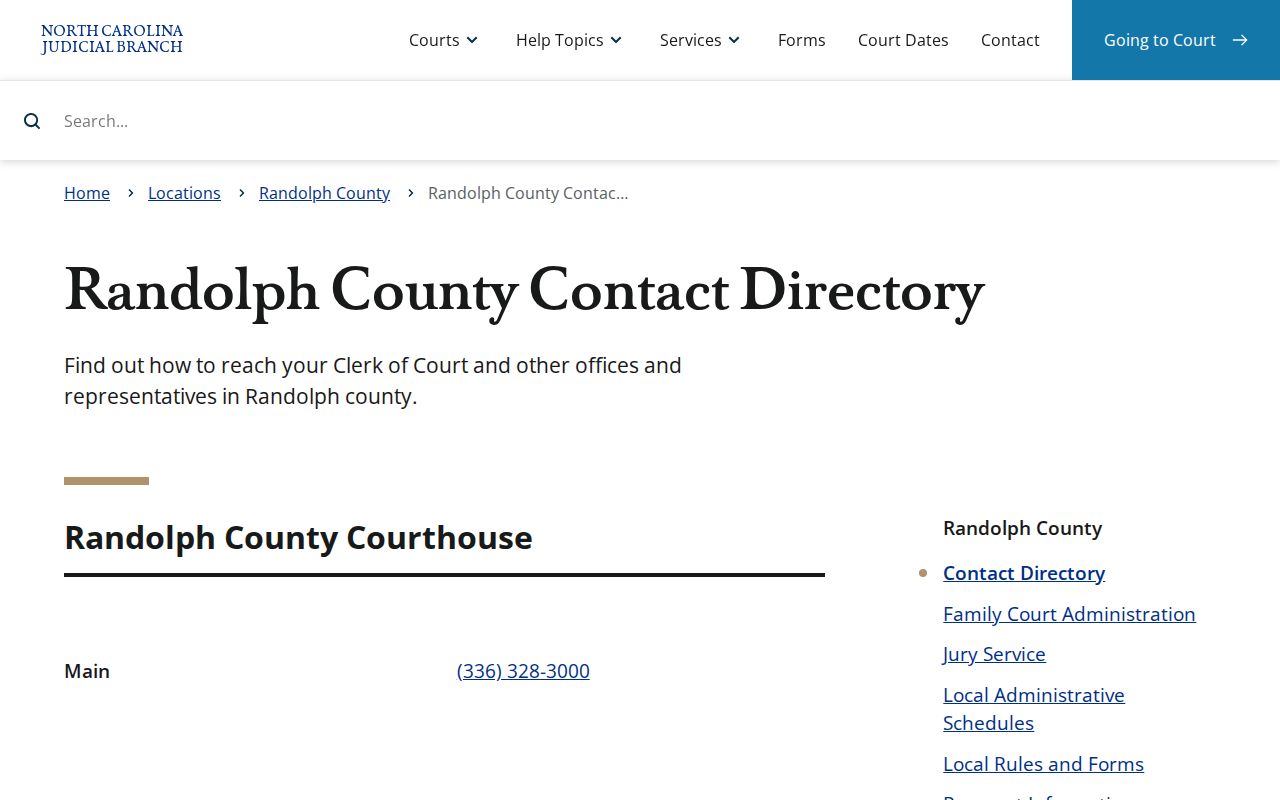
These contacts support the court half of verification, while the Sheriff remains the source for the county custody event.
Randolph Release Supervision and Alerts
NC DAC separates probation, parole, and post-release supervision. OPI's Active Probationer-Parolee category can show the exact community status and the displayed supervising office. The DAC Absconder Search is narrower. An absconder result means DAC reports the person absent from supervision; it does not prove a new conviction, a Randolph jail booking, or a present location.
NC SAVAN uses VINELink for county-jail and state custody notifications. Search the correct North Carolina person record, compare the reporting agency and identity, and read released or out-of-custody wording as agency-scoped. A transfer can end Randolph custody while confinement continues. Phone registration uses a PIN, and unacknowledged calls repeat at set intervals for 24 hours under DAC policy.
The North Carolina SBI Sex Offender Registry is a different system. It applies only to people legally required to register and cannot establish a release date. Registry alerts track registry information, not custody. For post-release status, choose the system that owns the exact event.
Randolph Federal Release Checks
A federal sentence belongs in the BOP Inmate Locator, which accepts a name or federal identifier and may show a release date or not-in-BOP-custody wording. Immigration custody belongs in ICE ODLS, using an A-number and country of birth or biographical details. An ICE no-result does not prove release because timing, spelling, transfers, and statutory coverage can affect the public result.
The U.S. Marshals Service holds many federal pretrial prisoners through local arrangements but has no equivalent public name locator. Ask the Randolph jail for the receiving agency, then use the federal court docket, responsible Marshals district, or BOP after designation. No BOP or ICE facility was found in Randolph County. These are destination checks, not assumed local release systems.
Randolph Released Inmate Record Sources
A source can be accurate yet answer the wrong question. The current jail list shows present Randolph confinement. The Sheriff release record can document how that booking ended. OPI records state custody and supervision, while BOP and ICE address separate federal systems. Compare the scope before drawing a conclusion.
| System | Best use | Important limit |
|---|---|---|
| Randolph current roster | Confirm current county-jail listing and save identifiers | A missing name is not proof of release |
| Sheriff release record | Confirm date, type, authority, and possible destination | Protected fields may be withheld |
| NC SAVAN | Receive agency custody changes and notifications | Out of one agency may still mean transfer |
| NC DAC OPI | Check prison release history and community supervision | Not a jail-only booking archive |
| Court Portal or clerk | Explain bond, judgment, dismissal, and disposition | Does not prove physical release time |
| BOP or ICE locator | Check federal prison or immigration custody | Each system has separate scope and timing |
Can a current roster entry prove that someone was not released? It shows that Randolph County listed the person as confined at the roster's production time. Because the county warns that status may change faster than updates, confirm urgent questions with the jail.
Randolph Release Facilities Differ
Two Asheboro facilities with similar names serve different legal populations. The Randolph County Detention Center is the Sheriff's county booking and jail facility. An expansion increased it to 422 beds and 101,091 square feet. People moved into new detention units in August 2021, and renovations to older jail areas ended in early 2024. County release questions belong with the Sheriff.
Randolph Correctional Center is a 226-capacity, minimum-custody male state prison operated by NC DAC. Its history reaches back to the state's 1931 assumption of county prisons and later field-unit development. A move from that prison to another DAC institution is not release. Community release should be checked through OPI for inactive incarceration, an actual release or last movement, and any active supervision.
Randolph County Release Facilities
Randolph County Detention Center holds county detainees and short-term county cases; release may mean bond, court order, time served, monitoring, or transfer. Randolph Correctional Center holds sentenced state prisoners and uses the statewide NC DAC record path. Naming the facility and operator at the start prevents a county booking from being confused with a state prison history.
- Randolph County Detention Center, county jail operated by the Randolph County Sheriff's Office.
- Randolph Correctional Center, state prison and reentry facility operated by NC DAC.
No separate municipal jail, federal prison, or ICE detention facility was found in Randolph County. Municipal arresting agencies can book people into the county detention center, and federal agencies can transfer people elsewhere without operating a local institution.