
Randolph County Parole vs Probation
North Carolina uses several labels for control in the community. Probation is ordered by a court, often instead of incarceration. Parole is discretionary early release from prison for an eligible older-law sentence. Post-release supervision, often shortened to PRS, is the required community portion of a covered prison term. A person can therefore be out of a Randolph County facility yet remain subject to rules enforced by the North Carolina Department of Adult Correction. The label matters because it identifies the legal source of the supervision and the record that should confirm it.
Structured Sentencing ended ordinary discretionary parole for offenses committed on or after October 1, 1994. Modern state-prison cases are more likely to involve PRS. Probation can follow a court disposition without proving that the person ever completed a prison term. Randolph County also has electronic house arrest and an Adult Day Reporting Center, which are forms of community control but are neither parole nor proof of a completed sentence.
| Status | How it begins | What confirms it |
|---|---|---|
| Probation | A court orders supervision, often in place of active time | The court disposition and NC DAC supervision status |
| Parole | The Commission grants early release for an eligible older-law prison term | NC DAC parole dates, status, and Commission records when applicable |
| Post-release supervision | A covered prison term moves into its required community phase | NC DAC incarceration and PRS status blocks |
| Pretrial control | A judge or magistrate sets a release condition | The court order and the local program administering it |
- Discharge
- The formal end of the stated term of supervision.
- Absconder
- A person whom NC DAC lists as absent from supervision, not a finding of a new offense.
- Detainer
- A request or hold from another authority that can affect custody or movement.
Verify Randolph County Supervision
The official starting point is the NC DAC Offender Public Information search. Its Active Probationer-Parolee category identifies people currently present in the community under DAC supervision. Search by the seven-digit offender number when known. A name search can be narrowed with a middle initial, birth date or age range, sex, race, ethnic group, or the Sounds Like option. Match several identifiers before relying on a result, since names and aliases can overlap.
Open the detail record and read incarceration and community status separately. Inactive incarceration paired with active probation, parole, or post-release status supports a release from prison into supervision. Active incarceration with a new location can mean transfer instead. The detail may also name a probation or parole office. That office should confirm current reporting information; it should not be guessed from a Randolph address alone.
- Choose All if the exact status is unknown, or Active Probationer-Parolee when community supervision is already expected.
- Enter an offender number or a name with enough matching identity details to avoid a false match.
- Open the record and compare incarceration, probation, parole, and post-release status blocks.
- Note the displayed supervision office and any start or end dates tied to the correct sentence.
- Use the official office directory or call Community Supervision to verify the current record.
The official Community Supervision page explains the division’s role. Its office directory is the proper route when a live OPI record identifies a district or local office. The broader Randolph County release search is useful when the first issue is whether the person left jail or prison at all.
The NC DAC local-office directory shows how office contacts are organized across the state.
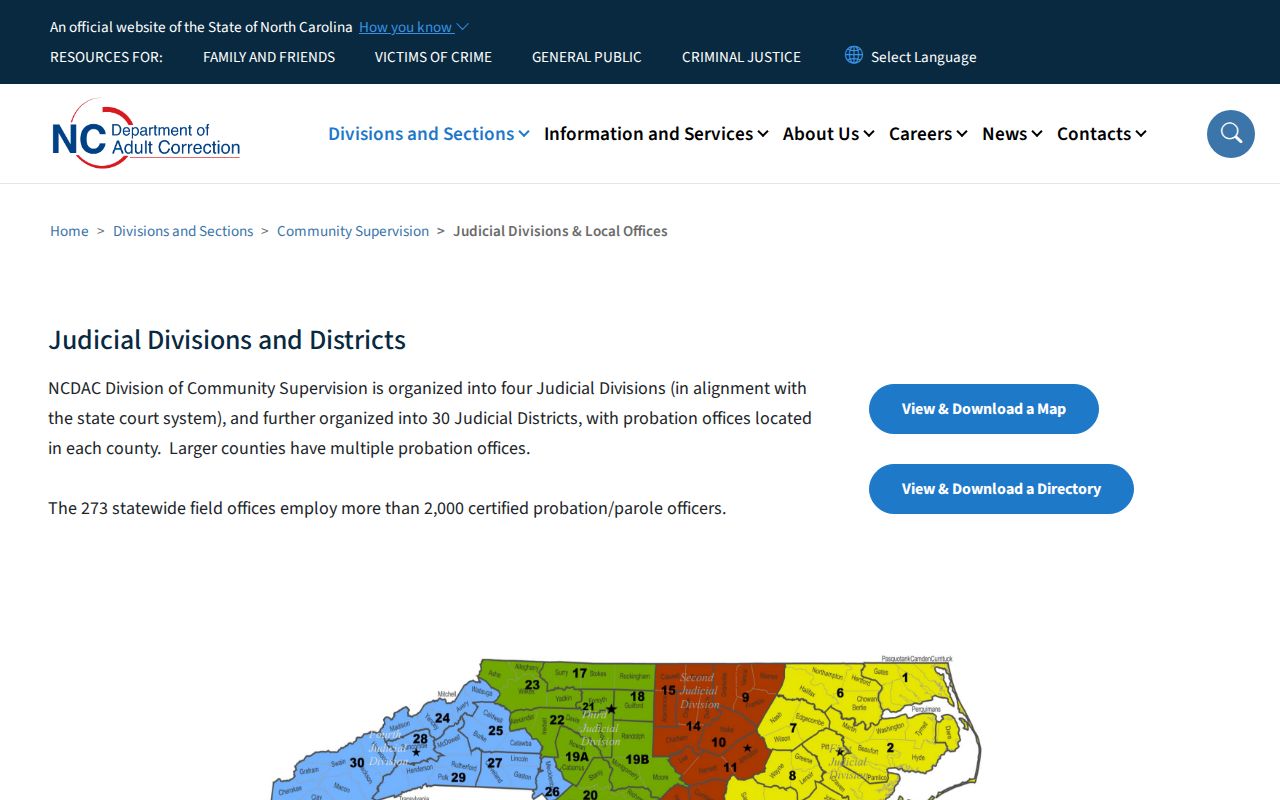
The directory is a contact path, while the person’s live OPI entry supplies the office that should be contacted.
Note: Inactive prison status paired with active supervision describes release into the community, not the end of all state control.
Randolph County Supervision Office
The research did not support a fixed Randolph reporting address from the official map. Publishing one by inference could send someone to the wrong office. Use the location printed in the matched OPI record and compare it with the current Community Supervision directory. Central Community Supervision can answer routing questions and confirm how to reach the correct district. Reporting rules, appointment sites, and assigned officers can change, so a general county association is not enough.
NC DAC Community Supervision
2020 Yonkers Road, MSC 4250
Raleigh, NC 27699-4250
Phone: 919-716-3100
Local office: confirm through the matched OPI record and official directory
A supervision office can verify an active status within the bounds of public information. Community-supervision files have confidentiality limits under G.S. 15-207, so the public record will not expose every case note or condition. Ask about the exact public status and office rather than seeking a complete internal file.
Note: The address in a person’s record can reflect a supervision location and should not be read as a prison location.
Randolph County Supervision Conditions
Conditions come from the controlling court order, Commission action, or post-release framework. A public status label does not reveal the full set. The person’s exact order and assigned office are the sound sources for reporting duties, permitted movement, treatment, testing, or other case-specific terms. A general OPI result should not be used to invent conditions that are not displayed.
Randolph’s local pretrial programs show why the source matters. Electronic house arrest can involve residence, location, testing, and monitoring rules after bond and approval. The Adult Day Reporting Center provides structured pretrial supervision, case management, counseling, and transportation. Those restrictions arise before case resolution and are not parole or PRS. A violation of one local condition must not be described as a parole violation without the actual supervision record.
When a condition may have changed, contact the office named in the live record. A court file may explain probation terms, while the Commission and DAC govern parole or post-release matters. NC SAVAN reports custody changes from participating systems, not compliance with each supervision condition.
Randolph County Absconder Records
NC DAC maintains a separate Absconder Search. It accepts a last name, a Sounds Like option, and County of Supervision, including Randolph. An absconder result means DAC records the person as absent from supervision. It does not by itself establish where the person is, whether a warrant remains active, or whether a new arrest or conviction occurred. A separate Randolph Sheriff public absconder or warrant list was not located in the official research sweep.
After finding a possible match, open the general OPI record and compare offender number, identity, supervision status, and office. Then contact the supervising authority. If the question concerns a later jail booking, check the Randolph current-confined roster separately. NC SAVAN can report custody changes from a participating agency, but it is not a supervision compliance ledger and should not be used as a parole-review calendar.
The official absconder form shows the Randolph county-of-supervision filter and name fields.
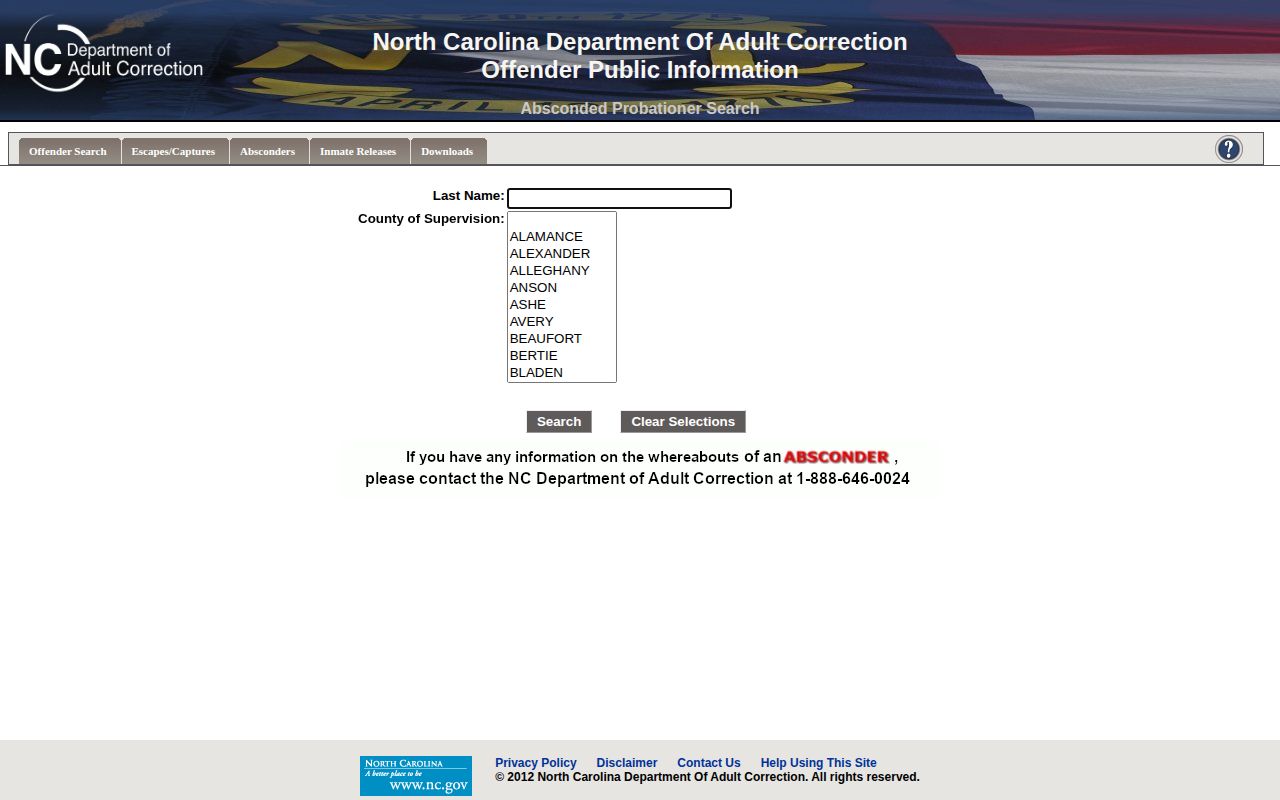
The form provides a focused lead, but the matched OPI record and responsible office provide the needed context.
Randolph County Parole File Reviews
The North Carolina Post-Release Supervision and Parole Commission does not hold formal parole hearings or meet personally with offenders during ordinary file review. Commissioners review cases one by one, and a majority is required for a decision. There is therefore no routine public calendar of future Randolph County parole hearing dates. Arranged victim input meetings and General Public Information Meetings are different processes, not adjudicatory hearings with the offender present.
The Commission’s Discretionary Parole Reviews page is the results substitute. It publishes monthly decision reports, not future hearing dates. Published explanations can include an incomplete decision pending more information, a suspended decision, early medical release, 90-day mandatory parole, or a statutory denial reason. Other Commission records may remain confidential.
Eligibility largely concerns older-law sentences. G.S. 15A-1371 supplies general eligibility and denial rules, but the calculation depends on the sentence and offense date. A projected release date in OPI is not a promise that parole will be granted. For a named person, compare OPI parole dates, the monthly report if applicable, and information permitted by the Commission at 919-716-3010.
Note: Monthly Commission reports document completed reviews; they are not a calendar of future Randolph County parole hearings.
Randolph County Supervision Discharge
Supervision ends through the event recorded for that particular case, not simply because an expected date has passed. OPI may show parole or supervision begin and end dates, sentence status, and whether the person remains an Active Probationer-Parolee. When all DAC status blocks become inactive, the public history indicates that the person is no longer active in those DAC categories. The record must still be matched to the correct identity and sentence.
A court disposition can explain the underlying probation judgment. Commission and DAC records explain parole or PRS. If a projected end date conflicts with an active status, contact the named office rather than treating the date as a completed discharge. Violations, revocation, amended orders, or another sentence can change the record. “Discharge” means the formal end of the supervision term; it is distinct from release from a jail door or transfer between facilities.
Mail After Randolph County Release
The Randolph County Detention Center documents an unusual post-release record path for mail. Ordinary postal mail sent to a detainee is scanned for tablet delivery, and the physical original is destroyed. After release, the former detainee may request digital copies of those scans by emailing jailmail@randolphcountync.gov with the detention center, inmate name, and inmate ID. After verification, the county sends a download link.
This process is personal mail recovery. It is not a parole record, probation file, or public booking-record request. County Evidence Control handles recovered property through a separate appointment-oriented process, and it should not be confused with ordinary intake property or scanned mail. Keeping those channels separate helps a released person reach the office that owns the actual item.